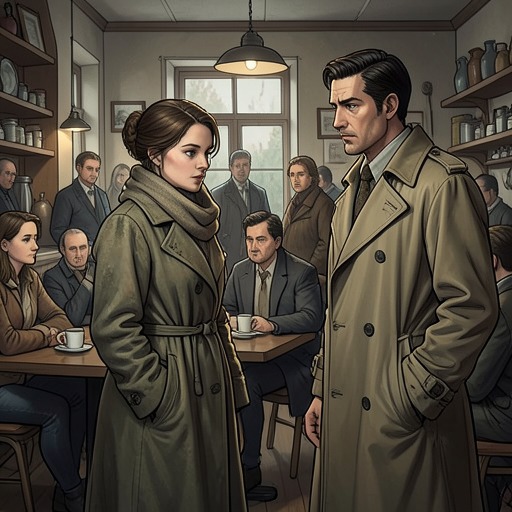
Alan Carstairs and Moira Nicholson’s acquaintance before her marriage
Why Didn't They Ask EvansAlan Carstairs and Moira Nicholson’s acquaintance before her marriage becomes a crucial but carefully bounded connection: she confirms that Alan knew her and had visited her shortly before his death, yet she had not told him where she lived or written to him after marrying. Their history gives a personal explanation for the arresting woman’s photograph Bobby Jones saw on the dead man, while also making the photograph’s later replacement part of the mystery of Alan’s murder and mistaken identity.
The Photograph and the First Clue
When Bobby found the dying stranger at the cliffs in Marchbolt, he put a handkerchief over the dead man’s face and noticed that a photograph had been pulled from his pocket. He glimpsed a woman who looked young, with fair hair and widely spaced eyes; what struck him was her unusually memorable appearance. He returned the photograph to the pocket without knowing whose face he had seen or why it mattered.
The public account soon seemed to settle the dead man’s identity by a different photograph. A newspaper report said the victim had been identified as Alex Pritchard by a picture of his sister, Amelia Cayman. Later, Bobby saw the reproduced image in the Marchbolt Weekly Times and recognized that it was not the photograph he had handled. The distinction between the private image he remembered and the printed image presented as identification turned an apparently reliable clue into evidence that something had been changed.
Moira Confirms Their Acquaintance
Much later, while Bobby questioned Moira about her fear of her husband, he asked directly whether she had known Alan. Her hesitation and the colour rising in her cheeks precede a clear confirmation. She had known him before her marriage, and he had come to see her once after it, about a month before the conversation with Bobby.
Moira could not say how Alan had learned where she was living. She had not told him and had not written to him since her marriage. The visit had therefore taken place without an invitation or explanation she could provide; she also said her husband did not know about it, although she accepted that he might have learned of it without telling her. The narrative leaves the means by which Alan found her unresolved, preserving the visit as a meaningful fact rather than supplying an unsupported account of how it was arranged.
A Private Connection, Not a Full Confession
Bobby’s question is prompted by a specific hypothesis: perhaps Moira had once given Alan her photograph. She confirms the suggestion, establishing that Alan possessed an image of her. In the context of the woman Bobby remembered from the dead man’s pocket, this admission connects the earlier visual clue to their acquaintance. It does not, by itself, explain when or under what circumstances she gave him the photograph.
Moira distinguishes the visit from any disclosure of her troubled marriage. She said that she had not yet begun to suspect danger, though she was unhappy. She had tried not to let Alan see that the marriage had failed, and Bobby gently suggests that Alan may have guessed despite her effort. When asked whether Alan might have suspected that the nursing-home establishment was not what it appeared to be, Moira recalls that he asked peculiar questions but thinks he did not truly know anything. Her recollection allows suspicion as a possibility, not a certainty.
Jealousy, Secrecy, and the Stakes of the Visit
The exchange also reveals why a meeting with an old acquaintance carried risk. Moira describes her husband as very jealous, including when he did not care for her, and says he regarded her as his property. She had nowhere to go and no money, and feared that others would dismiss a claim that her husband meant to murder her as an unbelievable story. Her account places Alan’s visit inside a marriage in which she felt trapped and watched, but it does not show that she confided those fears to him: she says she had not yet suspected her husband and had not told Alan she was unhappy.
That gap matters to Bobby’s inquiry. Alan may have noticed Moira’s unhappiness or asked questions about her circumstances, but the available recollection cannot establish what he understood. Their acquaintance is therefore neither an incidental biographical detail nor a complete explanation of his actions. It supplies a plausible link between Alan and the woman in the photograph while leaving the extent of his knowledge open.
The Connection and the False Identification
The inspector tells Frankie Derwent that the dead man had only one photograph on him and that it was of his sister, the image used to identify him as Alex Pritchard. He dismisses reports of multiple photographs as newspaper exaggeration. Set against Bobby’s memory and Moira’s confirmation that Alan had her photograph, this official account sharpens the discrepancy: the woman Bobby saw and the sister’s picture in the report cannot simply be treated as the same image.
Bobby and Frankie reason that, if there had been only one photograph, someone must have removed the one Bobby returned and substituted another before the police arrived. Their suspicion focuses on Roger Bassington-ffrench, whom Bobby remembers being present at the scene; at this stage, they treat the substitution and the suspected murder as deductions, not as independently verified facts. Moira’s testimony gives the missing photograph a likely personal identity and makes the false identification more intelligible, but the relationship’s narrative force lies precisely in how much it reveals and how much remains uncertain. A private history becomes legible through an object that has passed through several hands, while the public identification conceals the dead man’s true identity.